Showing posts with label systems biology. Show all posts

Tuesday, 24 July 2012

Buddy-cops! Why evolution favours the odd couple

Inside our cells, the battle with viruses has a lot in common with 1980s action-comedy Lethal Weapon: both feature unlikely pairs of heroes. Each partnership  - virus-battling proteins and LA cops alike - has a reliable, straight-laced, by-the-book one and a loose canon, maverick one. 

buddy cop proteins police our cells
Mel Gibson as loose canon Martin Riggs paired with Danny
Glover as straight-laced cop Roger Murtagh.
(Lethal Weapon, 1987)
In the cell, buddy-cop proteins police many of life's
important processes.
New research suggests that whether they're crime fighting or fighting an infection, the odd couple always gets the job done.

Life inside our cells may look very complex, but it's actually all a bit of a cheat. Evolution killed off what didn't work early on and copied what did work in massive amounts. Like 'buddy-cop' movies from the 1980s our cells are full of repeated bits, common sets of rules, re-used ideas. After all, why mess with a winning formula?

Research published recently in Nature Molecular Systems Biology has found a familiar pairing at the heart of several of life's processes: proteins which behave very differently, thrown together to protect and serve the cell.

Dr Alexander Ratushny and colleagues at the Seattle Biomedical Research Institute, USA, examined a duo of proteins called Interferon Regulatory Factors (IRFs), which defend  our cells against viruses. They found one of the proteins, IRF7,  responds to a viral threat in an all-or-nothing way, using positive feedback to boost its activity. Its partner protein, IRF3, is more sensitive, reacting to the developing situation by reigning in its partner when needed.

too many loose canons
Tango and Cash (1989), a repeated buddy-cop formula.Turning
both partners into mavericks can have destructive results in
the cell, too.
Dr Ratushny's team identified similar partnerships in control of how our cells grow, balancing our cholesterol levels and at the heart of our early development.

The team used mathematical models (using algebra to simulate genes and proteins) to compare how well different combinations of proteins work together - asking which type of pairing could quickly respond to a threat, how sensitive they were to changes in the threat and, most crucially, how balanced the partnership was.

The model of the chalk-and-cheese, 'asymmetric' pair was the only one "predicted to be reliably controlled, which is critical for balanced yet rapid, antiviral and inflammatory responses".

cop and a half
Although the buddy-cop formula
is often repeated, not all examples
work as well as others.
So why have these buddy-cop proteins evolved? What makes them more favourable than, say, pairs of 'maverick' all-or-nothing proteins?

If you've seen the end of 'Tango and Cash' you'll know the answer already - a pair of loose canons can be very destructive. Similarly, when Dr Ratushny's team forced both members of a 'buddy-cop' protein duo to work under positive feedback (inside yeast cells), the results were overkill - their response was too strong. 

It appears that evolution used trial and error to find that the odd couple is the only way to get results.

Drug developers (not the kind found in Lethal Weapon) may now look for ways to trigger the wiring in our cells with an asymmetric pair at its core, such as the wiring connecting the liquorice root to diabetes.

There are also fresh ideas here for synthetic biologists looking to artificially coax a maverick protein into working with straight-laced partners inside our cells.

When they do, you may see a post here comparing their efforts to 1984 fish-out-of-water comedy "Beverly Hills Cop".

Reference:

ResearchBlogging.org Ratushny AV, Saleem RA, Sitko K, Ramsey SA, & Aitchison JD (2012). Asymmetric positive feedback loops reliably control biological responses. Molecular systems biology, 8 PMID: 22531117

Thursday, 31 May 2012

Want to build the perfect smartphone? Take a lesson from your cells

cells and smartphones multitask
The multitasking smartphone has
only been evolving for 20 years.
Today's smartphones could do better. Yes, they send texts, make video calls, talk to satellites, take, edit (and share) your pictures, play games and music... one even makes a whipping noise if you waggle it a bit. Some of them can make phone calls too. But surely there's so much more that could be crammed in?

The human cell has functionality that would put any smartphone to shame. The secret, as new research investigates, was learning how to multitask.

Smartphones are still evolving. They're getting smaller, lighter and more streamlined. At the same time consumers are demanding 'more connectivity!', 'more integration!'. They want Apps that talk to other Apps; Facebook statuses that automatically log GPS positions, whips that crack by themselves. Maybe they're spoilt, or perhaps this is all part of the evolution: people expect more because the technology promises so much. Increasing the  "smartness" of your next phone will probably require a balance between efficiency and functionality. Apps must share software and hardware; in order for you to multitask so must your phone. Perhaps there is a lesson for smartphone developers inside mammalian cells.

The wiring inside our cells has evolved over millions of years to overcome problems with multi-tasking. In a recent paper published in PLoS Computational Biology, Jeffrey Wong and colleagues found that, surprisingly, being flexible isn't always the best option.
apps in the cell
The cell has evolved over millions of years.
Inside, thousands of proteins multitask to
co-oridinate and control its 'Apps'. And it's only
~1/100 of a centimetre across. Beat that, smartphone!

The team from Duke University, North Carolina, investigated the wiring of the E2-Factor (E2F) network, a system of proteins inside the cell which changes its structure to control both the cell cycle (enabling the cell to grow and proliferate) and apoptosis (programmed cell death), making E2F one of life's most important multitaskers.

They asked a simple question: what happens when you increase the demand on the wiring? How does the cell cope?

The team built a mathematical model of E2F's wiring, using algebra in place of genes and proteins. They then ran simulations to see if it was possible for E2F to multi-task by compromising its structure to cope with several tasks at once.

Yes - the model predicted - but only for tasks that were similar. Different tasks would pull E2F in opposite directions, making a compromise not only hard to find, but damaging. As the strain or "tension" in the network increased, it would become less "robust" and liable to break or crash (which may sound familiar to smartphone users who have ever tried to run multiple Apps at once).

But what if - suggested the model - what if E2F could change its structure dynamically between competing tasks; or even duplicate part of its wiring to cope with the tug-o-war?

This all makes a lot of sense if we look at what we know about human evolution. Previous studies have shown that the E2F network does dynamically change in structure during the cell cycle. Also, mammals have evolved a set of similar E2F proteins, some of which share tasks.

Dr Wong believes E2F (and other systems in our cells) evolved to mimise the tension in our cells' wiring. He suggests that multitasking in this way is an "evolutionary feasible" way of "reusing a common set of components... to accomplish multiple biological goals."

Maybe smartphone developers could take some useful multitasking tips from inside their cells? They might just save themselves millions of years' worth of trial and error.


What does this mean for me?
This study improves our understanding of the design of the cell - how has it evolved? and why? Answering such questions is essential not just for our knowledge but also for scientists attempting to understand how the cell changes in diseases such as cancer.

What does this mean for science?
Models built from algebra are used to simulate everything ftrom air traffic to climate change to volcanic ash clouds. They've been used in biology for almost a 100 years. Here a model is put to good use as part of a Systems biology approach. Their model was built based on prior knowledge (of E2F), and then made experimentally-testable predictions: in this case for the behaviour of E2F when different demands are placed on its wiring. The authors suggest that synthetic biologists might find "vast potential" in the different ways a single system can reorganise themselves to multitask.


Reference (open-access article, freely-available as PDF here):

plos computational biologyWong JV, Li B, & You L (2012). Tension and robustness in multitasking cellular networks. PLoS computational biology, 8 (4) PMID: 22577355 
ResearchBlogging.org This post was chosen as an Editor's Selection for ResearchBlogging.org

Tuesday, 17 April 2012

Feedback

Jimi Hendrix.
Master of feedback, burner of guitars.
At six in the morning, on 18th August 1969, Jimi Hendrix took to the stage at the Woodstrock festival. In amongst his two and half hour set were many of his hallmarks - smashed guitars, fires, unpredictable guitar solos, playing behind the head and with teeth, and a new technique which Hendrix himself had invented.

Newspapers described his new effect as a protest against the Vietnam war because it sounded like "falling rockets". It was, simply, feedback.

Biologists (and Physicists) might qualify that a little - it was "positive" feedback. The vibrations from Jimi's guitar strings fed down into his guitar's pickups and across the stage in a wire. The sound was amplified and pumped back at the crowd. But it didn't end there.

Jimi turned to point his Fender at a wall of amplifiers so the sound caused new vibrations aross the strings. These fed back down through the guitar's pickups again, were amplified again, and spat back at his guitar again... The loop repeated, building and boosting until it reached a scream. Then, well... it was anyone's guess what Jimi would do next!
Positive feedback.
It happens in our cells as well.

In nature feedback is everywhere. 

Positive feedback loops happen in all of the cells in our body, and have done since the day we were born.
 
A protein called Cyclin B, for example, is boosted by positive feedback. As Cyclin B levels rise, they have a knock-on effect on another protein, Cdc25 which boosts Cyclin B even further. Just like Jimi with his Strat, biologists call this "amplification". Without amplification of Cyclin B our cells couldn't divide.

The natural world has also evolved forms of negative feedback, which has the opposite effect: instead of amplifying higher and higher it pushes back, reducing noise to silence or, in some cases, producing ellaborate cycles and patterns.

To see how, let's forget guitar heroes and cells for a moment and think about foxes and rabbits.

Rabbit and fox, prey and predator

In the wild, a thriving rabbit population naturally leads to a healthy surge in the population of foxes looking for an easy meal. The rabbit population inevitably falls, which leaves the fox population hungry so, after a delay, it too begins to fall. With fewer foxes around, the rabbits begin to multiply again...The two populations - predators and prey - are locked together, they rise and fall repeatedly. They oscillate.

Negative feedback.
Guess what? It happens in  our cells too.
Negative feedback loops are the driving force behind all sorts of biological oscillations - everything from seasonal changes to our heart beats to the hundreds of proteins wired together in our cells to control the response to diseases. (more about those in another post!)

On stage, Jimi Hendrix played around with negative feedback too. His wah-wah pedal used negative feedback to cancel-out some frequencies of sound whilst boosting others. Combining negative and positive feedbacks helped Jimi to define a new era of guitar playing.

It's no suprise that inside the cell, to achieve its incredible range of different functions, many sets of proteins are wired into positive and negative feedback loops which are also wired to each other! 
Jimi using feedback during "Star-spangled banner"
Woodstock festival, 1969

For more on biological cycles, have a look at this. I'll be writing on what oscillations actually do inside cells in a later post!

ResearchBlogging.orgReference (one of the earliest):

VOLTERRA, V. (1926). Fluctuations in the Abundance of a Species considered Mathematically Nature, 118 (2972), 558-560 DOI: 10.1038/118558a0

Sunday, 1 April 2012

The explosive, moving, crushing, slightly depressing, exciting reality of the cell (and how it's a bit like a red Ferrari).

My first wheels.
My first experience of driving a car was totally reckless. At top speed I mounted the kerb, grinning at passers-by as I slammed into a wall. I then leapt out of the seat, vaulted the wall, and ran off in search of criminals.

Granted, I was pretending to be Magnum P.I at the time and had a top speed of how fast a 3 year-old can scoot along whilst sitting down. But the thought was there: this is easy, let’s open this baby up on a slope, see what she can do.

When I finally got behind the wheel (of a Ford Escort, not a Ferrari), some 15 years later, the reality came as quite a shock - there were gears, and brakes and stuff to check and top-up. So many things to remember when I just wanted to screech around the place - and this was all before I’d even looked under the bonnet/hood. But, like everyone else I learnt, because... well, that’s the reality if you want to drive.

The depressing reality of the car (but beautiful to some)
When I first looked down a microscope at some cells, I was similarly astonished. These cells weren't all the same shape or size, they weren't staying still, in fact they were twanging around the place. And inside? Inside it looked like complete chaos. 
The cell in front of me was a microscopic machine: millions of proteins crashing together and breaking apart; some were building the cell from within, or acting as scaffolding, or fighting infection, or making copies of DNA before ripping the enitre cell neatly in two every 24 hours.
The GCSE cell, simplified but still correct.
(Credit BBC Bytesize 2011)
Our cells are full of moving parts. And if we want to fix them when they go wrong, such as when a cell becomes cancerous, we first need to understand how they work - how all these parts are wired together. It's quite a daunting and slightly depressing challenge - how on earth do we go about it?

One way is to work on smaller pieces of the cell first. Just as a mechanic will work on the exhaust system, the electrical system and the cooling system of an engine, cell biologists might specialise in the p53 DNA damage system, the NF-kappaB sgnalling system or the cell cycle.

In the end, would-be cell biolgists face a choice - to look at the horrific, awe-inspiring complexity of the cell's wiring and either run screaming or accept that there's lots to see, roll up your sleeves and get your hands dirty!
The horrific, but beautifully complex, wiring of the cell.
Up to you... do you want to know more?
Download this poster as a PDF from Cell Signalling.
In future posts I'll tell you how scientists have looked under the cell's bonnet/hood, what they've found out about its systems and their wiring, and what the future might hold...

Tuesday, 27 March 2012

Too many live wires

Hello to anyone and everyone who has found themselves here! The idea behind this blog is to offer a fresh perspective on the complex life inside living cells. 
Tools of the trade: Pipette.
Used by biologists to mix precise
amounts of liquid such as DNA
in solution. (For hours on end.
Whilst tied to a lab bench.)

Why listen to me?

I am a systems biologist. I look inside cancer cells to examine the wiring between different genes and proteins which might be at fault. Then, because this wiring is often tangled, I get up from the microscope or lab bench and plonk myself behind a computer.

It is here that we use whatever we’ve been able to see to build a virtual model of parts of the cell. These models allow us to make sense of all of the information we see and, more importantly, to predict what might be happening to what we can’t see.

I’ll go into what Systems Biology actually is in a later post.


My posts will also try to answer questions like:

What does the latest “scientists find the gene for <insert something horrible here>” headline actually mean?

What’s in the research papers from around the world that most newspapers don’t report on?

and also…

How do I get into biology if I have a maths or computer science background?

and the tricky one... What are scientists actually like?

Wiring inside cancer cells: HeLa cervical cancer cells, enigneered in a dish to glow different colours
 as they prepare to go through cell division. We can learn a lot about the cell's inner wiring from
measuring how quickly these "traffic lights" change.
Watch the movie here!

I hope this blog will be unique, useful and <gulp> even entertaining! Any technical jargon will be explained, messages will hopefully be clear, and I won’t go on for pages and pages with some lofty opinion or other. I will hopefully be posting every two weeks (at least) and, unlike most blogs, there won’t be any recipes.

Apart from this one.

Tomato, caper and mint pasta sauce

(serves 4)
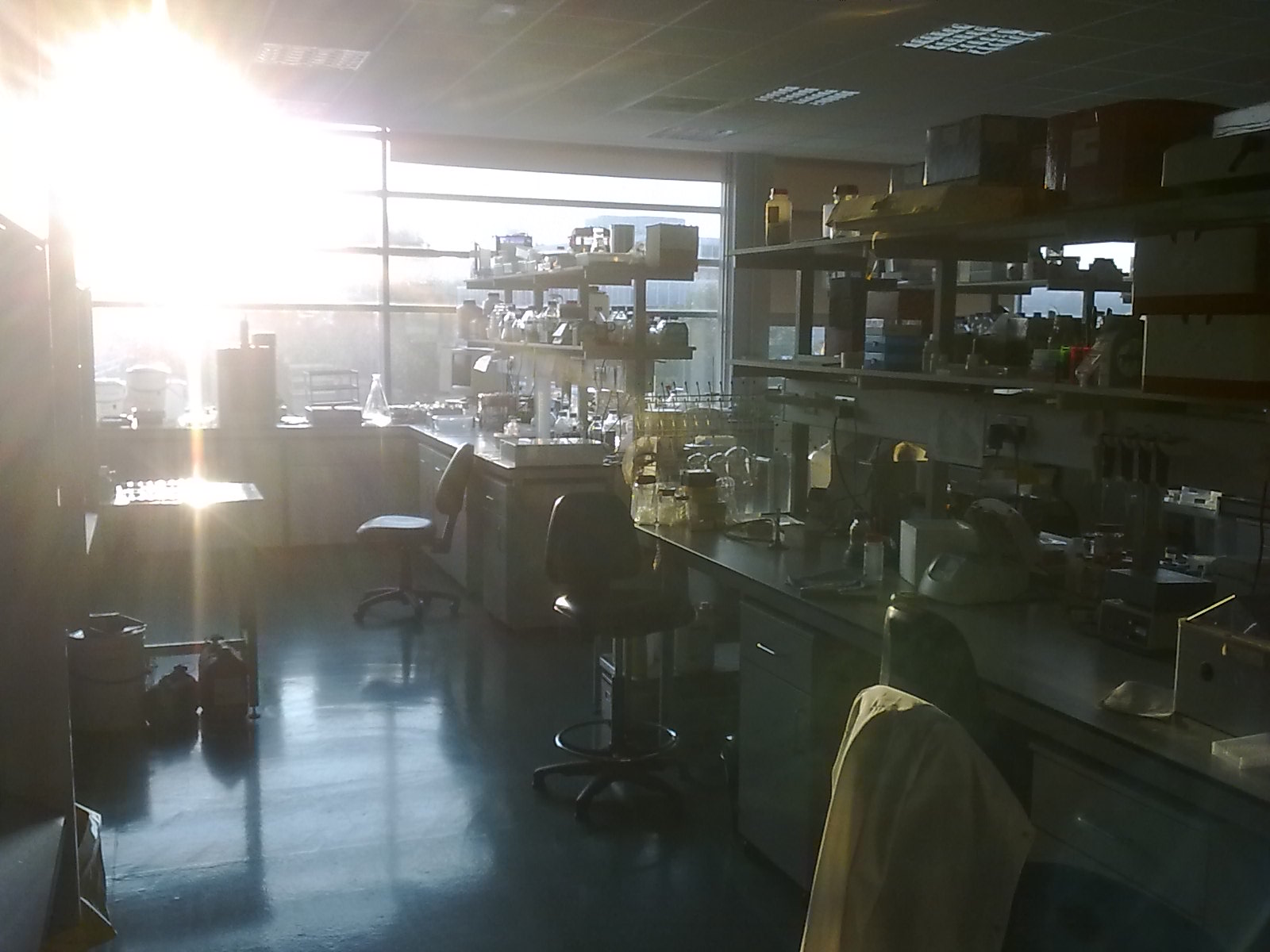
The lab. Science is a lot like cooking really.
Ingredients:

1 decent handful of spaghetti
2 tins of chopped tomatoes
1 large clove of garlic, crushed
2 tbsp olive oil
2 tbsp capers, drained
1/2 tbsp tomato puree
1 handful chopped mint
1 handful chopped basil
pinch of chili flakes
salt
pepper


Recipe:
Warm the olive oil in a pan over a medium heat, then add the garlic.
After 5 minutes or when garlic starts to brown, remove garlic and add tomatoes. Stir.
Simmer for 5 minutes then add puree and chili. Stir again.
Leave simmering for 10 minutes adding salt and pepper as you like.
Whilst this is bubbling away cook the pasta in salted water.
With one mintue to go add the capers, mint and basil. Stir well.
Drain pasta, serve and spoon over the sauce.

Enjoy!


Many thanks to Professor Mike White, Dr Dave Spiller and Rick Stein.